
The era of “set it and forget it” SSL/TLS certificates is officially over. Driven by Apple, Google, and the CA/Browser Forum, the industry is moving toward significantly shorter certificate lifecycles. This isn’t just a minor administrative update—it is a fundamental shift in how organizations must manage digital trust and security.
This blog breaks down the timeline of these changes, the operational risks involved, and why automation is no longer optional.
To understand where we are going, we have to look at where we’ve been. The industry has been aggressively shortening certificate validity for over a decade to improve security and “cryptographic agility.”
We are moving from a world of years to a world of weeks. Here are the hard deadlines you need to know:
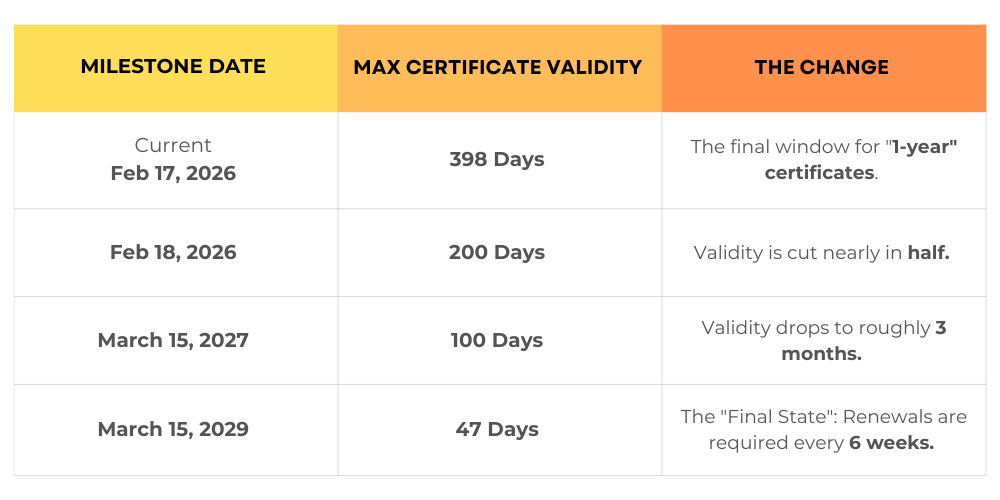
The current 398-day SSL certificate validity offers a clear operational advantage over the upcoming 200-day lifecycle. A longer validity period means fewer renewals, fewer reissuances, and significantly lower administrative effort for security and IT teams.
With a 200-day validity, certificates will need to be reissued more frequently, increasing manual workload, coordination across teams, and the risk of missed renewals or service disruptions. Buying and renewing a 398-day certificate now helps maintain operational stability, reduce management overhead, and buy valuable time before shorter lifecycles become mandatory.
This is a one-time opportunity—once the new rules take effect, 398-day SSL certificates will no longer be available.
Starting in February 2026, the standard “one-year” SSL certificate effectively disappears. As a business owner or IT decision-maker, you will face a fundamental change in your infrastructure management:
After February 18, 2026, the way you buy and use certificates changes forever. Even if you purchase a “3-year subscription” from your provider, the identity file (the certificate) on your server must be replaced every 200 days.
This creates a “Reissue Treadmill”:
The primary goal is Cryptographic Agility. Shorter lifespans provide three critical security benefits:
Many organizations have already invested in multi-year SSL subscriptions, and with upcoming changes to certificate validity rules, it’s natural to wonder how existing certificates will be affected.
In practical terms, an SSL subscription purchased for multiple years remains valid. However, each certificate issued under that subscription will now follow a shorter validity period. As a result, certificates will need to be issued or reissued more frequently to align with evolving browser and industry requirements. The scenarios below explain how these changes apply based on the certificate issuance or reissue date.
Scenario 1: Certificate Reissue Date Before 18 February 2026
Scenario 2: Certificate Reissue Date On or After 18 February 2026
After February 2026, the margin for error becomes razor-thin. A single missed renewal in a 47-day cycle could take your site offline before you even notice the expiration warning.
Contact our experts for more assistance.

If you have any questions, feel free to call us toll-free
Toll-Free Call: +91 +91-22-42978097




The End of 1-Year SSL Certificate Validity: What Organizations Need to Know